Building Offline-First SaaS in LATAM: Real Lessons from RutaPOS and Huella
Introduction
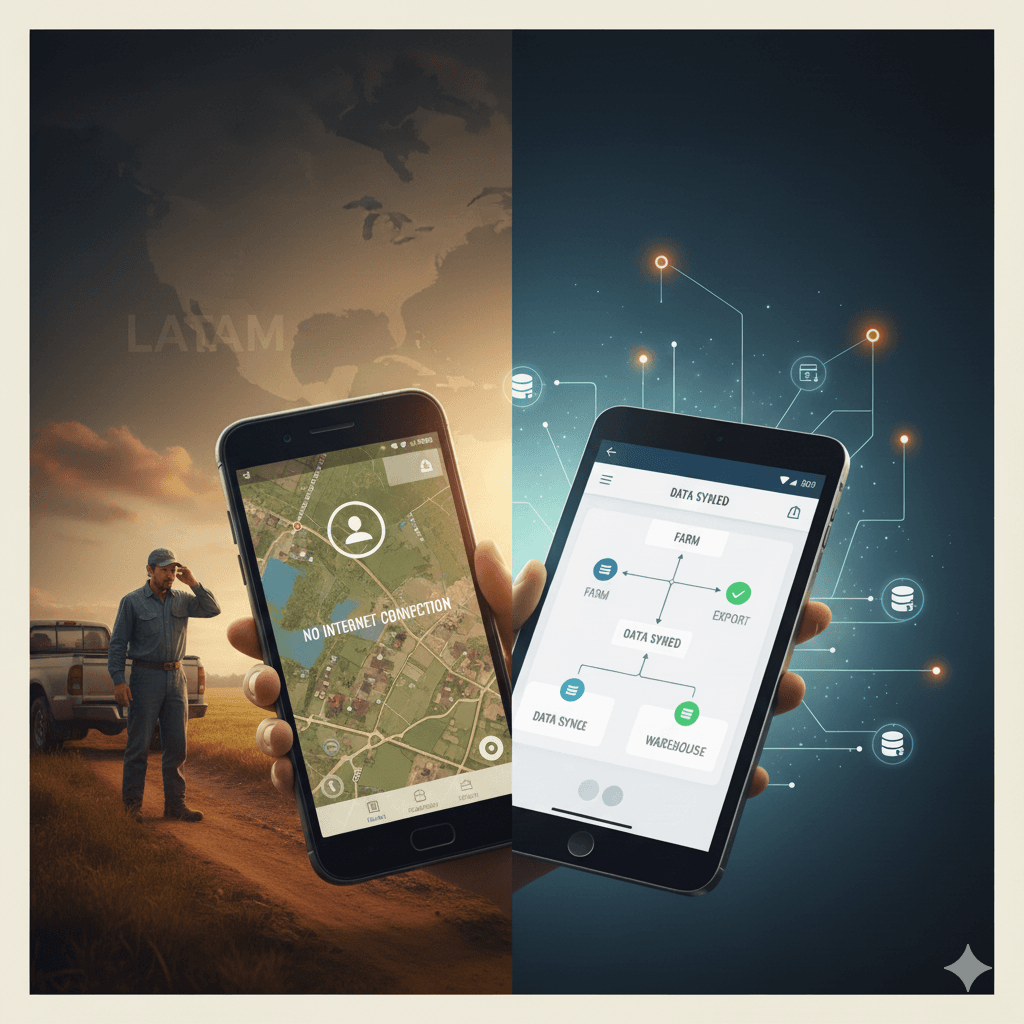
Over the past few years, I've worked on designing and building two SaaS platforms in very different industries: RutaPOS, a multi-tenant inventory and route management system for retail and warehouses, and Huella, a coffee traceability platform that follows product data from farm to export.
Despite targeting different markets, both projects faced the same core challenges common in LATAM:
- Intermittent or unreliable connectivity
- Mobile users operating in the field
- Multiple actors and roles per organization
- Business-critical data that cannot be lost
These constraints forced architectural decisions that go beyond standard "web app + backend" thinking.
This article shares real-world architectural decisions, trade-offs, mistakes, and lessons learned while building offline-first, multi-tenant SaaS platforms for real operations.
1. The Real Problem: SaaS Is Not Just Web + Backend
Many SaaS architectures implicitly assume:
- Stable internet connections
- Desk-based users
- Continuous access to the backend
In both RutaPOS and Huella, that assumption failed immediately.
Users needed to:
- Operate mobile apps offline for hours or days
- Create and update critical data in the field
- Sync safely once connectivity returned
This led to a non-negotiable conclusion:
Offline-first is not a feature. It is a business requirement.
2. High-Level Architecture Overview
Both platforms converged on a similar high-level architecture:
Backend
- A multi-tenant SaaS backend
- Clear tenant isolation
- Role-based access control
- API-first design
Mobile Applications
- Designed for offline-first operation
- Local database (SQLite / Room)
- Sync queues and retry mechanisms
- Conflict detection and resolution
Synchronization
- Controlled synchronization
- Incremental pulls
- Event-based pushes
- Idempotent backend endpoints
This structure allowed the system to remain usable even when the network was not.
3. Multi-Tenancy Defined from Day One
One of the most important decisions was treating multi-tenancy as a first-class domain concern, not an afterthought.
In practice, this meant:
- Every core entity belongs to a tenant
- Tenant scoping enforced at the query level, not just in the UI
- Role and permission checks applied consistently across APIs
The benefits were immediate:
- Strong data isolation
- Easier scaling across organizations
- A solid foundation for future white-labeling
Retrofitting multi-tenancy later would have been extremely costly.
4. Offline-First: What Worked and What Didn't
What Worked Well
- Local persistence using SQLite / Room
- UUIDs generated client-side
- Explicit sync states (pending, synced, conflict)
- Backend APIs tolerant to retries
What Did Not Work
- Full data syncs on every connection
- Trusting device timestamps
- Resolving conflicts only on the frontend
The biggest takeaway:
Synchronization is a business problem before it is a technical one.
5. Domain Modeling Before Technology
In both projects, success depended far more on domain understanding than on framework choices.
Examples:
- A "sale" in RutaPOS is a stateful process, not a single record
- A "coffee lot" in Huella changes state multiple times across actors and locations
The process was always:
- Model real workflows and edge cases
- Define state transitions and failure scenarios
- Choose technology that supports those constraints
Without strong domain modeling, no architecture can hold.
6. Security, Auditing, and Operational Safety
Because these platforms handle operational and financial data, security and traceability were mandatory.
Key practices included:
- Per-tenant logging
- Audit trails for sensitive actions
- Scoped tokens and permissions
- Strict environment separation (dev, staging, production)
This made real-world support, debugging, and enterprise usage possible without compromising safety.
7. What I Would Repeat and What I Would Improve
I Would Absolutely Repeat
- Designing multi-tenancy from the start
- Treating offline-first as a core requirement
- Keeping backend and frontend loosely coupled
- Maintaining living documentation
I Would Improve
- Introducing automated tests earlier
- Stress-testing sync conflict scenarios sooner
- Adding observability before user growth
Conclusion
Working on RutaPOS and Huella reinforced a key lesson:
The hardest problems in SaaS are not framework-related. They come from understanding real operations, imperfect environments, and business constraints.
If you are building SaaS products in LATAM or similar regions, design for unreliable connectivity, real users, and complex workflows from day one.